


How Grüns Increased Email Signups by 55% and Popup-Attributed Revenue by 67% With Alia
Grüns makes comprehensive daily nutrition easy, and genuinely enjoyable, through convenient, great-tasting gummies. Alongside its flagship product, the brand has grown into a multi-brand portfolio that includes Nütrops, Immün, Jüced, and Müves.
Grüns has always treated its email and SMS popup as one of the most valuable pieces of real estate on its site. When its once-winning mini-quiz popup started to fade, Grüns moved every brand to a fully managed Alia plan and lifted popup-attributed sales 67% and email submissions 55% with Smart Triggering.
+67%
Increase in popup-attributed sales from Smart Triggering
+55%
Increase in email submissions from Smart Triggering
+55%
Increase in SMS submissions from Smart Triggering
+30%
Increase in email submit rate from a winning pick-a-card experience
TL;DR
The Full Story in 60 Seconds
Challenges
- A mini-quiz popup that had once outperformed began losing effectiveness as the format became common across DTC sites
- Visitor fatigue with a familiar experience was pulling down opt-in rates on the brand’s most valuable acquisition surface
- Opt-in growth had to come without hurting sitewide conversion rate or bounce rate
- Testing velocity was limited by how much the team could build and manage across multiple brands
- One generic layout served every visitor, with only page-level copy changes
Solution
- Migrated every brand in the portfolio to a fully-managed Alia plan
- Built a shared testing roadmap and a weekly opt-in report by brand
- Paired the mini-quiz with gamified formats that invite participation before asking for information
- Timed popups to each visitor’s predicted intent rather than fixed rules
- Tailored asks by audience, including SMS-only asks for existing email subscribers and subscription offers for one-time purchasers
- Held every test to guardrail metrics and rolled winners out across the portfolio
Results
- +67.3% popup-attributed sales from re-engaging visitors who didn’t sign up the first time
- +53.9% attributed orders from re-engaged visitors
- ~11% increase in revenue per popup view, overall vs. the previous period
- +15.5% email and +13.7% SMS opt-in rates, overall vs. the previous period


If your popup is your most efficient acquisition channel, which it is for most DTC brands, Alia is how you get the most out of it. The AI targeting beats rules-based triggers, the formats are more engaging, the testing is rigorous, and the team is a true partner that keeps bringing ideas.

Sam Gardenswartz
SVP, Ecom & LTV, Grüns
CHALLENGES
The Most Valuable Real Estate on the Site Had Hit a Ceiling
Most brands treat their popup as a necessary interruption. Grüns has always treated it as a strategic asset: the first real conversation with a new visitor, and one of the most cost effective ways to acquire customers.
Before switching to Alia, Grüns used its popup to capture email and SMS subscribers while collecting valuable customer data through a short mini-quiz. By asking shoppers about their goals, whether that was improving energy, gut health, or immunity, the team could tailor welcome messaging to each subscriber’s interests.
The approach worked, but as more DTC brands adopted the same quiz-led format, shoppers began to recognize it. What once felt novel started to feel routine, and opt-in rates drifted down.
"The mini-quiz was successful at first, but as more and more brands used it, it got tired and started performing less well."
For a brand that considered its popup one of its most efficient acquisition channels, slow decay carried a real cost. Declining opt-in rates meant fewer opportunities to turn paid traffic into subscribers and ultimately, customers. With acquisition costs rising, Grüns needed to capture more value from the traffic it was already paying for, without compromising sitewide conversion.
"We’ve always treated the email and SMS popup as one of the most valuable pieces of real estate on our site."

Sam Gardenswartz
SVP, Ecom & LTV, Grüns
SOLUTION
Defining Success Beyond Submit Rates
When Grüns looked for a new approach, the goal was clear: raise email and SMS opt-in rates across every brand in the portfolio. But a higher submit rate alone would not count as a win.
The real targets sat behind it. Grüns wanted to lower CACs and grow popup-attributed revenue, without giving back sitewide conversion rate or increasing bounce rate. A popup that captured more emails by getting in the way of purchases would simply move the problem somewhere else.
That framing shaped the partnership. Grüns chose Alia for a fully managed service that could run an aggressive program across multiple brands, reporting deep enough to measure what actually mattered, and a broad range of on-brand formats to test against existing popups. Migration across the portfolio required no lift from the internal team.
"Implementation was fast and easy. Alia covered all the work for us across brands. It couldn’t have been easier."
That mattered more than it might seem. For a lean ecommerce team running several brands, every hour spent rebuilding popups is an hour not spent on strategy. Removing that work is what made a far more ambitious testing program possible.
Making the first interaction feel like part of the brand. Grüns didn’t abandon what worked. The mini-quiz stayed, because the insight it captured still powered personalized welcome flows. What changed was everything around it: when the popup appeared, who saw what, and how visitors were invited in.
Timing came first. With Smart Triggering, Grüns brought the popup back to visitors who had dismissed it, at the moment their behavior signaled renewed interest, rather than re-showing it on a fixed rule or not at all. Shoppers likely to engage saw it at the right moment, while visitors focused on browsing or buying were left alone. That protected sitewide conversion while lifting opt-ins.
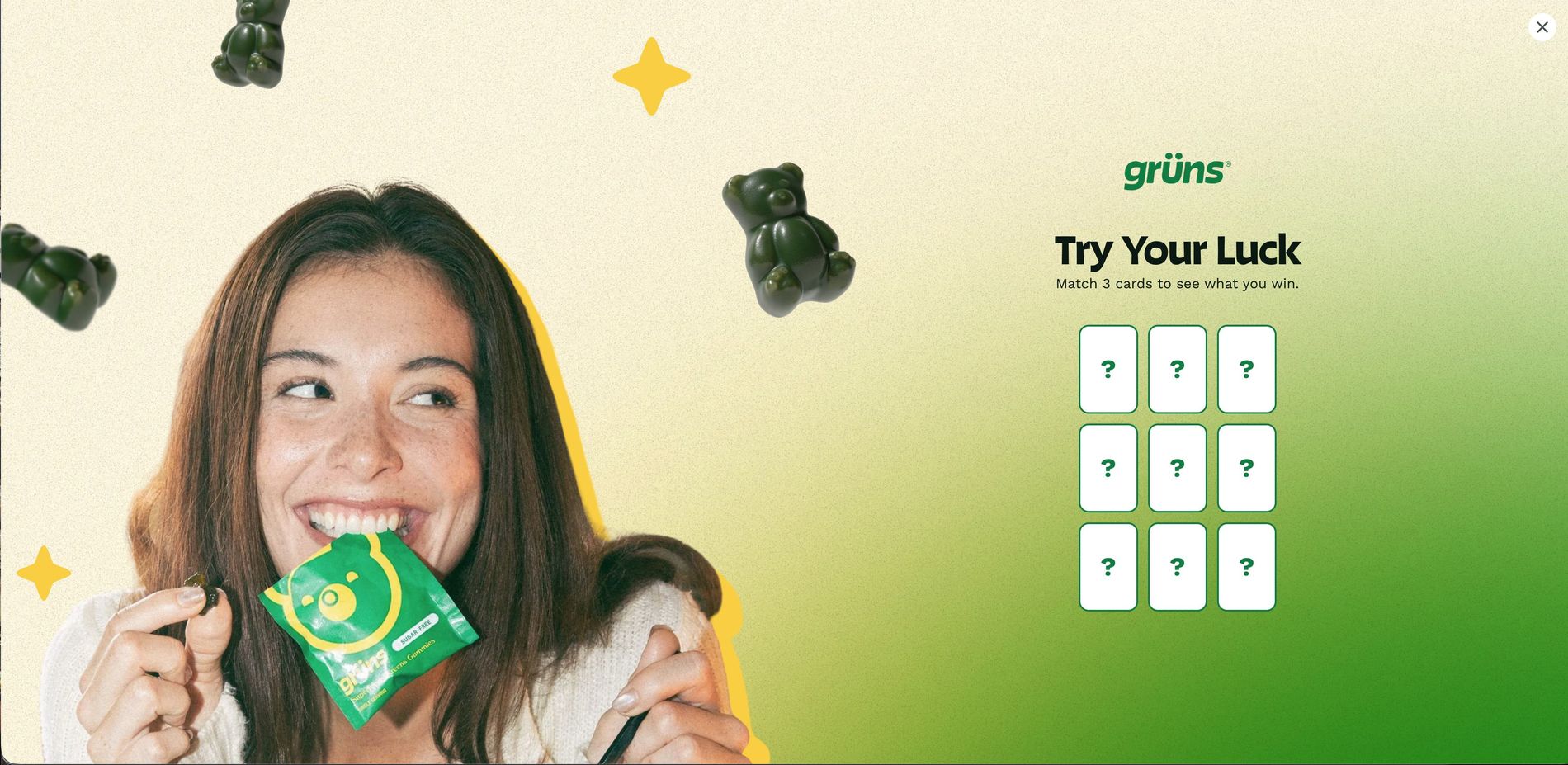
Next came the format. The team layered gamified experiences on top of the quiz, giving visitors something to participate in before asking for their information. Scratch-offs and card games turned a familiar ask into a small moment of play, a better fit for a brand built on making nutrition feel fun. Even the details were tested: a four-card game beat a nine-card version, a reminder that less friction often wins.
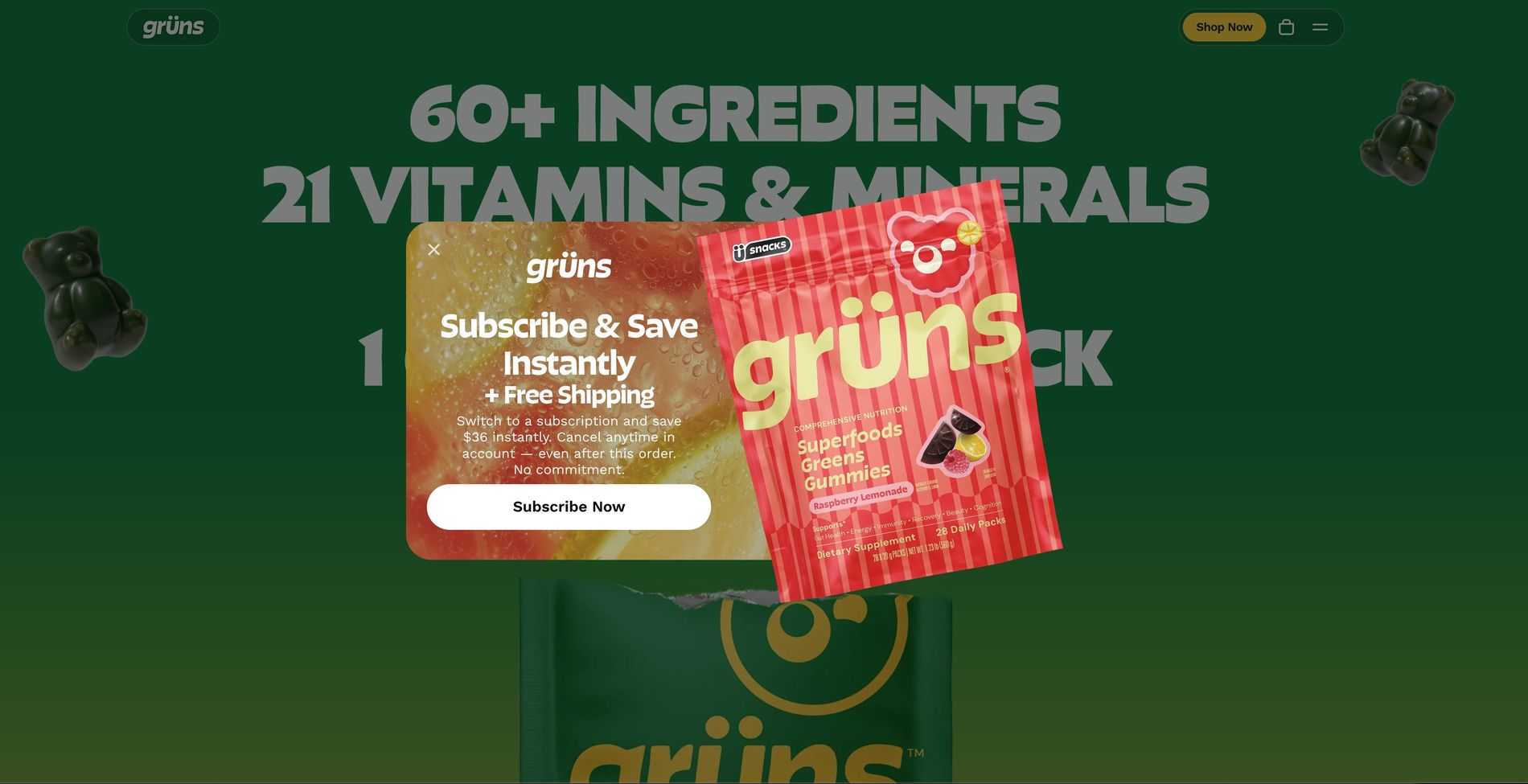
Finally, the team stopped treating every visitor the same. Shoppers already on the email list saw only an SMS ask, rather than being asked for information Grüns already had. One-time purchasers saw a subscription offer that showed their exact dollar savings.
That shift expanded what the popup was for. It was no longer only a list-building tool. It became a lifecycle surface capable of moving customers toward higher-value behavior, including the subscription relationship that drives LTV in supplements.
From occasional tests to an always-on growth program. The biggest change wasn’t any single experience. It was how Grüns ran onsite acquisition as an ongoing program.
Before, the team experimented with treatments and rolled out winners. Now, Grüns and Alia share a testing roadmap, review a weekly opt-in report for each brand, and run a steady stream of tests on triggers, creative, offer framing, format, and personalization.
That portfolio effect is a meaningful advantage. Each brand works as a testing ground for the others, so a lesson learned once compounds across every storefront.
Rigor increased alongside volume. Every test carries guardrail metrics, including attributed conversion, sitewide conversion rate, bounce rate, and time to purchase. Grüns keeps a control running even when a variant looks strong on submit rate alone. Tests are all judged on what they do to the business, not just the popup.
More tests, held to a higher standard, produce better decisions. Over time, that discipline turns the popup from a static site element into a learning engine for the entire acquisition strategy.
"We were able to use Alia to test popups outside of email and SMS opt-in. For example, we used it to upsell one-time purchase customers into a subscription very successfully."
Sam Gardenswartz
SVP, Ecom & LTV, Grüns


More Return From the Same Acquisition Spend
All results cover September 8 to October 8, 2026. Re-engaged visitor results compare performance with and without Alia’s Smart Triggering.
Key Performance Metrics
Popup-Attributed Sales:
+67.3% increase in popup-attributed sales from Smart Triggering
Email Submissions:
+55.3% increase in email submissions from Smart Triggering
SMS Submissions:
+54.9% increase in SMS submissions from Smart Triggering
Pick-a-Card Experience:
+30% increase in email submit rate from a winning pick-a-card experience
"We have a richer, always-on testing program. When something wins on one brand, we roll it out across the portfolio."
Results
- +67.3% Popup-Attributed Sales From Smart Triggering: Most popups get one chance: if a visitor closes it, that opportunity is gone. Smart Triggering gave Grüns a second one, showing the popup again to visitors who didn’t sign up the first time, at the moment they were most likely to convert. That lifted popup-attributed sales 67.3% compared with performance without it. The revenue came from visitors Grüns had already paid to acquire, which makes it the most direct way a popup can improve CAC: more return from the same acquisition spend.
- +55.3% Email and +54.9% SMS Submissions From Smart Triggering: The second, better-timed chance brought in 55.3% more email submissions and 54.9% more SMS submissions. Each one was a visitor Grüns had already paid to acquire, now an owned relationship the team could convert through quiz-personalized welcome flows, and that is what fed the revenue gains.
- +30% Email Submit Rate From a Winning Pick-a-Card Experience: Rather than relying on a static offer, Grüns tested interactive formats that invite visitors to play before asking for their information. The winning pick-a-card experience lifted email submit rate 30% compared with the standard mini-quiz popup. It shows how Grüns’ testing program works: every format is tested against revenue-focused guardrails, and winners are rolled out across the portfolio.
"We can now run way more tests across all of our brands because of how seamlessly it manages them. We’re therefore getting a lot more learnings."
The Takeaway: Every Format Has a Half-Life
Grüns’ story is a reminder that no onsite experience stays effective forever. Formats that win get copied, shoppers adapt, and performance quietly decays. The brands that keep growing are not the ones that find a perfect popup. They are the ones that build a system for continuously finding the next one.
Three principles made that system work:
- Grüns judged the popup on business outcomes, not submit rate, so every gain was real.
- It treated visitors as different people with different relationships to the brand, so each ask fit the moment.
- And it turned testing into an operating rhythm, so a lesson learned on one brand compounded across the portfolio.
For most DTC brands, the popup is the most efficient acquisition channel they have. The question is whether it’s managed like one.

"If your popup is your most efficient acquisition channel, which it is for most DTC brands, Alia is how you get the most out of it. The AI targeting beats rules-based triggers, the formats are more engaging, the testing is rigorous, and the team is a true partner that keeps bringing ideas."
Your Success Story
Starts Here
Starts Here
Join leading ecommerce brands using Alia to improve acquisition efficiency, grow owned audiences, and turn more visitors into long-term customers.
