

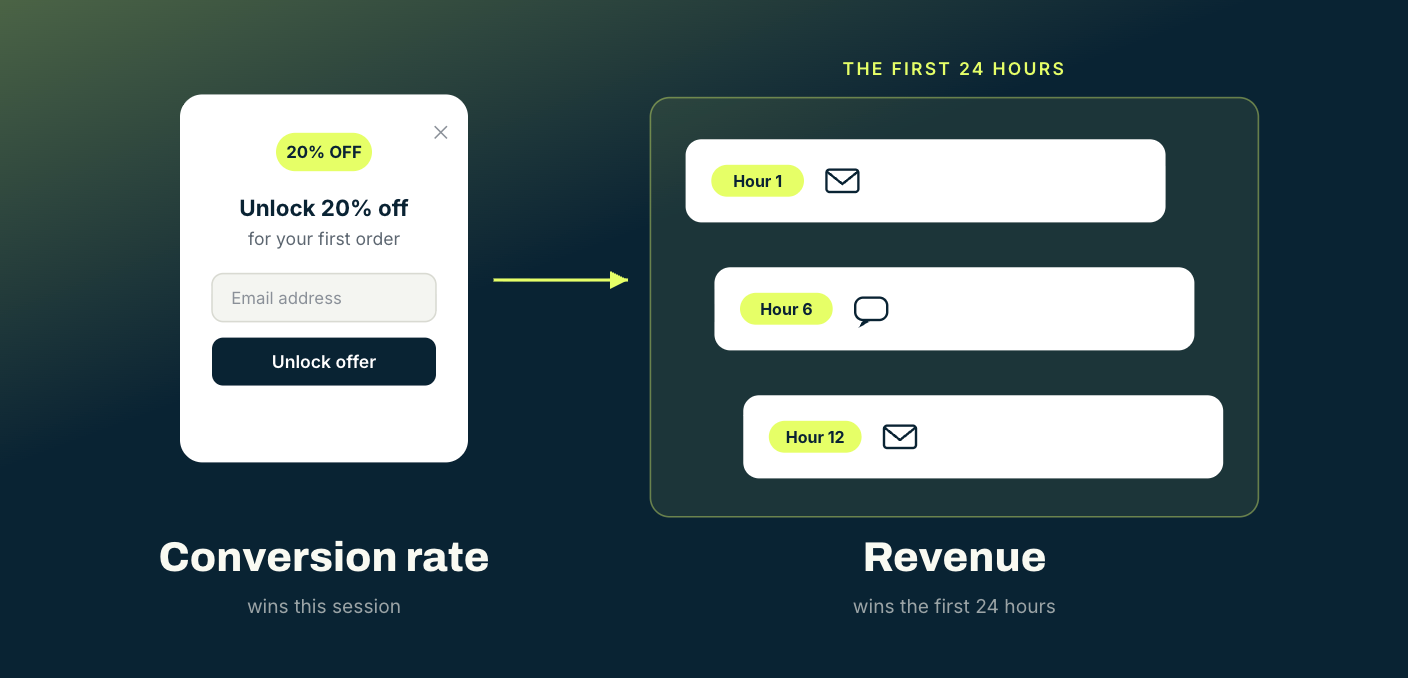

Pull the first-purchase timing report on almost any DTC store and you get the same lopsided curve: the overwhelming majority of first orders happen within 24 hours of the first visit. A shopper who leaves without buying tonight has, in all likelihood, left for good, no matter what we tell ourselves about nurture sequences. So the whole acquisition question compresses into one day, and into the 2 tools that own it: the popup, which works on the shopper while they're on the site, and the welcome flow, which goes after them once they leave.
Most brands give these 2 tools the wrong jobs. They assume the popup is the main revenue driver and don't pay enough attention to the welcome flow, which ends up built like a newsletter, a week of brand storytelling sent to someone whose buying window closes before the second email arrives.
The popup's job is to convert the session
Once the popup's job is the session, the design decisions stop being a matter of taste. It should look and feel like part of the store, not a gate in front of it: brand fonts, brand voice, real product photography, so it doesn't read as an interruption. Timing follows the same logic. A popup that fires the instant the page loads is asking a stranger for their email before they've seen a single product.
Leverage Alia's Smart Trigger feature which uses AI to decide when each visitor should actually see the popup, instead of a fixed delay that treats every visitor the same. It's worth A/B testing Smart Trigger against a static delay to see which one converts better on your store.
And you don't need to strip the popup down to a single email field to protect the session. Alia is built to sit inside the visitor's session, on brand and matching your website's design, so the signup can be a small journey of its own: the visitor scratches a card or picks a gift box, unlocks their reward, enters their email, adds their phone number for SMS, and gets the reward, all in the same session. Then they carry on shopping exactly where they left off.
Then there's the offer itself. Be careful what you're actually giving away here, because the popup sits in front of all your traffic, including every cold visitor arriving from ads, and a big discount handed to all of them is margin you never get back. Test an evergreen offer first: if your products are already discounted on site, say $20 off or $5 off, use that as the reward the visitor unlocks. You're collecting the email address either way, and the discount was already there.
Give the reward on the thank-you page, not in the inbox
Your highest-intent visitor of the day, someone interested enough to hand over their email mid-browse, taps submit and reads: "Check your inbox for your code." Follow them for a second. They leave your store, open Gmail, and find your code sitting in the promotions tab between a competitor's sale announcement and 40 unread newsletters, every one of them a reason to keep scrolling instead of coming back. Somewhere in your analytics this registers as a successful capture. What actually happened is that you built an exit-intent popup that manufactures exits.
The reward belongs on the thank-you page. Show the code the second they sign up, auto-apply it at checkout, and let the session carry on exactly where it left off. The email with the code still goes out, but its job changes: it becomes the backup and the retargeting hook, not something your best prospect has to go and fetch. This one change matters most, because a popup that sends its hottest lead away from the site is a conversion tool working against conversion.
The welcome flow is a retargeting tool
Everyone who signed up and didn't buy is a hot prospect with a window that's already closing, so the flow front-loads. Email 1 goes out within minutes, restating the reward, showing the best sellers, offering one obvious road back to the store. In most accounts we run, that first email out-earns the rest of the flow put together, so give it the design and testing attention that number deserves.
The emails that follow should all land inside the first 24 to 48 hours, not spread across a week. This is where you handle whatever is stopping the purchase: reviews and proof, answers to the objections you already know about, and a reminder that the reward has an actual expiry date. No need to invent a countdown, the real one works better. Make sure there's a placed-order filter so buyers leave the flow the moment they convert, because nobody should get "still thinking it over?" an hour after their order confirmation. And save the founder story, the ingredient deep-dives and the rest of the brand content for the days after the window, where they help build the second purchase instead of getting in the way of the first.
The poll answer from the popup pays off here too. If someone told you they're buying a gift, remind them of the deadline and offer a gift note. If they care about ingredients, send them the science. If they hesitated on price, show them the value math. Same flow, but each person gets a first day that matches why they came.
Score each tool on the metric it owns
The popup answers to conversion: inside Alia's analytics, follow views to engagement to signup, then look at the figure that actually settles arguments, the conversion rate of sessions that interacted with the popup measured against sessions that never saw it. That comparison is the popup's entire performance review.
The welcome flow answers to revenue: revenue per recipient, and how much of that revenue lands in the first 48 hours. That's where most welcome flows leave money on the table.
Scored this way, the roles are clear. The popup's job is to convert sessions and to arm the flow with an address and an answer. The flow's job is to pull non-buyers back before the window closes. Run both jobs deliberately and you're working the first purchase twice: while the shopper is on the site, and through the 24 hours after they leave.
Copy the exact email flows we run across 140+ DTC brands
Our swipe file is the playbook from running email for 140+ DTC brands: how to build each flow, how to set it up so it makes the most money possible, and that includes the welcome flow playbook you just read about.
Open the swipe file → emailkong.com/swipe-file