


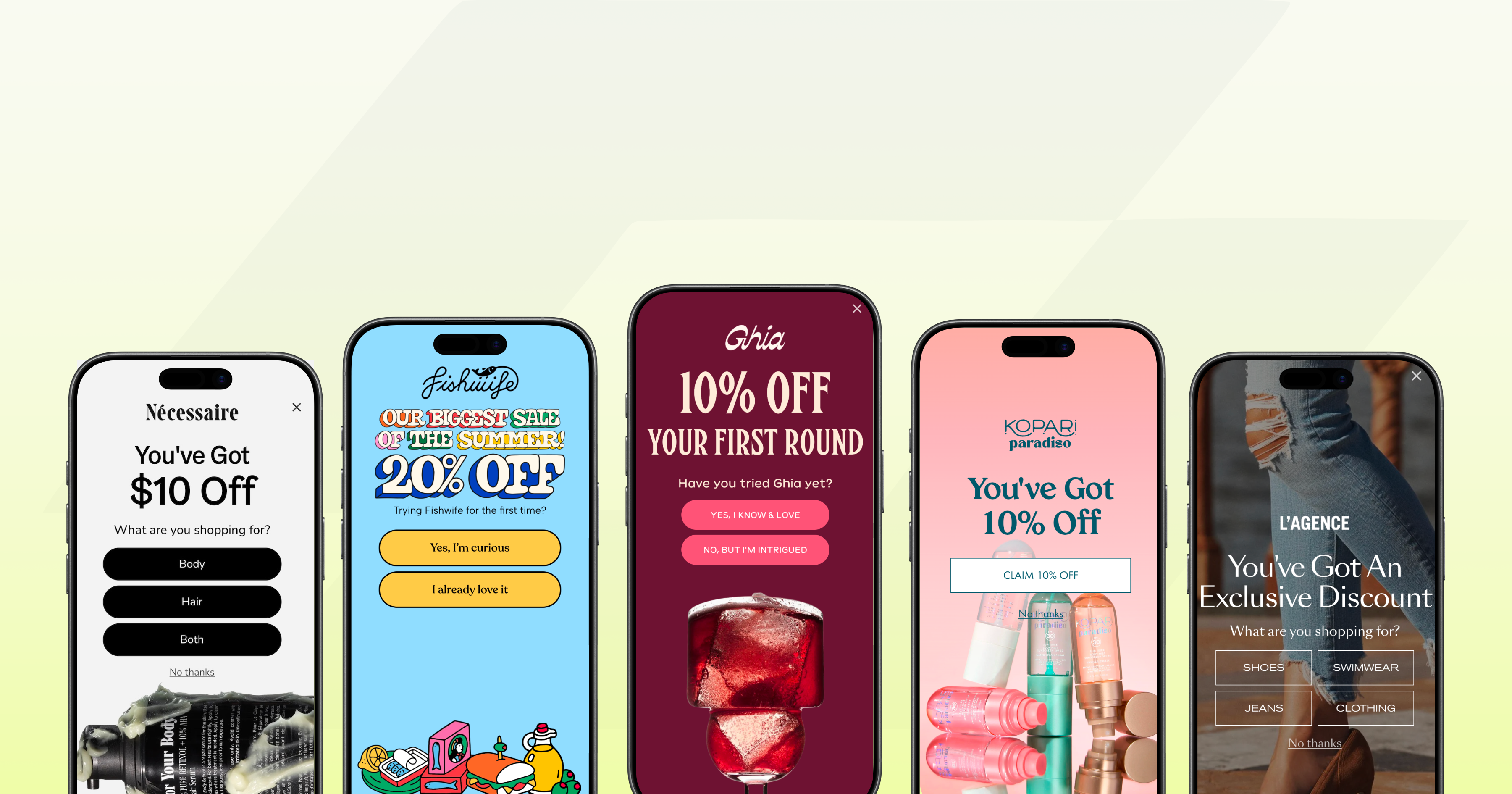

Over the past several years, ecommerce growth strategies have become increasingly dependent on paid acquisition. As paid media platforms evolved, brands were able to scale customer acquisition efficiently despite inefficiencies elsewhere in the funnel. But that environment has changed.
Customer acquisition costs continue to rise across nearly every channel, while competition for consumer attention has intensified. At the same time, privacy changes, attribution challenges, and market saturation have made performance marketing less predictable than it once was.
For many brands, profitable growth now depends less on driving more traffic and more on extracting greater value from the traffic they already paid for. This is forcing brands to rethink the onsite experience, particularly the role of onsite acquisition.
Historically, popups and signup forms were treated primarily as list growth tools. Success was measured through surface-level metrics like submit rate and subscriber volume, while the experience itself remained largely static: identical offers, identical timing, and identical messaging shown to every visitor regardless of customer journey or intent.
Leading ecommerce brands are beginning to approach acquisition differently. Rather than viewing the popup as a standalone email capture tool, they’re treating it as a critical component of acquisition efficiency, lifecycle marketing, and overall revenue growth.
The popup is no longer just a list-growth tool. It’s becoming one of the first conversion and personalization layers in the customer journey.
The Economics of Acquisition Have Changed
When customer acquisition costs were lower, brands could afford inefficiencies throughout the customer journey. Generic onsite experiences were less of a problem because traffic was relatively inexpensive and scalable.
Today, the margin for inefficiency has narrowed considerably.
A visitor arriving onsite is no longer simply another opportunity for list growth; they represent marketing spend. The onsite experience determines how effectively brands convert that acquired traffic into subscribers, customers, and downstream revenue.
The quality of onsite acquisition impacts far more than list growth. It influences:
- First-purchase conversion rates
- Welcome flow performance
- Quality of customer segmentation
- Personalization capabilities
- Discount dependency
- Customer lifetime value
Simply put, onsite acquisition is becoming the connective layer between paid acquisition and lifecycle marketing. Brands that fail to optimize that layer are often increasing ad spend while underutilizing the traffic they already paid for.
Why The Traditional Popup Model is Becoming Less Effective
Most popup strategies were built around a relatively simple objective: maximize opt-ins. That mindset shaped the tactics that became standard practice across ecommerce:
- Aggressive discounting
- Immediate popup timing
- Static targeting rules
- Uniform messaging
- Minimal personalization
While these approaches worked for a while, consumer expectations have changed. Shoppers interact with acquisition experiences constantly, making one-size-fits-all popups increasingly easy to ignore; heavy discounting has created long-term profitability concerns for brands; and static acquisition experiences fail to reflect how much visitor intent varies.
A first-time visitor arriving from a paid social campaign behaves differently than a returning customer navigating directly to a product page. Similarly, a lower-intent browser in the discovery phase requires a different experience than a high-intent shopper actively exploring products.
Treating these visitors identically often creates an experience that feels disconnected, intrusive, and far less effective than it could be. As a result, more brands are moving away from static popups and toward more adaptive, personalized experiences.
Strategic Areas for Onsite Acquisition Optimization
The most effective onsite acquisition strategies today prioritize relevance. Rather than relying on one universal popup, brands are tailoring acquisition flows based on visitor behavior, engagement patterns, customer journey, and purchase intent.
1. Personalization and Audience Segmentation
One of the most significant limitations of traditional popups strategies is the assumption that every visitor should be served the same experience. In reality, visitor intent varies significantly across acquisition channels, sessions, and stages of the customer journey.
More sophisticated strategies incorporate segmentation variables such as:
- Traffic source
- Product category interest
- Returning vs first-time visitor status
- Cart behavior
- Geographic region
- Customer history
Even relatively lightweight personalization can improve both conversion rates and user experience by making acquisition interactions feel more relevant. This also improves subscriber quality. More personalized experiences tend to generate stronger downstream engagement and conversion performance, not simply higher opt-in volume.
2. Dynamic Timing and Behavioral Triggers
Many brands are still relying on static triggering rules such as fixed time delays or scroll-depth thresholds. While simple to implement, these approaches rarely account for actual engagement.
Behavior-based timing models perform better because they align popup display with real engagement signals rather than arbitrary rules. For example, visitors demonstrating strong purchase intent through product exploration or extended session engagement may benefit from earlier interaction timing. Conversely, lower-intent visitors may require additional browsing time before engaging with a popup. Optimized timing reduces interruption while creating more natural customer experiences and thus, stronger conversion performance.
3. Moving Beyond Submit Rate as the Primary KPI
One of the most important strategic shifts for optimized onsite acquisition is moving away from submit rate as the dominant success metric. While submit rate remains useful, it provides an incomplete picture of subscriber quality.
Two popup experiences may generate the same submit rate while producing entirely different business outcomes. One may drive higher-intent subscribers who convert quickly and purchase repeatedly, while another may generate lower-quality opt-ins that inflate list growth without meaningfully impacting revenue. As acquisition costs rise, understanding that difference becomes increasingly important.
That’s why it’s important for brands to evaluate performance against broader business outcomes including:
- Revenue per subscriber
- First-purchase conversion rate
- Average order value
- Time to purchase
- Repeat purchase behavior
- Customer lifetime value
The goal is no longer just generating more subscribers. It’s generating subscribers who are more likely to convert, repurchase, and drive long-term revenue.
4. Zero-Party Data Collection as a Personalization Layer
Traditional signup forms typically capture little more than contact information, limiting personalization capabilities downstream. Increasingly, brands are using onsite acquisition to gather voluntary preference data that improves segmentation and messaging relevance across the customer lifecycle.
Examples include:
- Product preferences
- Shopping motivations
- Category interests
- Styles preferences
- Intended use case
Many brands already invest heavily in personalizing their welcome flows, but the acquisition experience itself remains generic. Collecting preference data earlier helps create a more connected experience from the very first interaction. When implemented thoughtfully, these data points can power more relevant welcome flows, stronger product recommendations, and more personalized retention marketing.
5. Reducing Dependency on Blanket Discounting
While discounts remain effective conversion tools, reliance on blanket offers can erode margin, condition consumer behavior, and reduce pricing flexibility over time. More advanced onsite acquisition strategies align incentive levels with visitor intent. High-intent visitors may convert effectively with lower promotional pressure, while lower-intent shoppers may require stronger incentives or alternative value propositions. This more nuanced approach allows brands to improve conversion efficiency while maintaining greater control over profitability.
6. Continuous Testing
Paid acquisition teams have long understood the importance of continuous testing. Creative, messaging, and audience targeting are constantly being iterated on to improve performance and efficiency. Yet onsite acquisition experiences often remain unchanged for months at a time, despite being one of the highest-leverage conversion points in the customer journey.
Popup performance is influenced by numerous variables including:
- Headline structure
- Offer framing
- CTA language
- Visual hierarchy
- Mobile experience
- Form length
- Overall design
The most successful brands are no longer evaluating these variables solely against opt-in performance. Instead, they’re measuring how these variations impact broader business metrics and revenue, allowing brands to identify acquisition experiences that generate not only more subscribers, but more valuable customers.
Onsite Acquisition is Becoming a Revenue Lever
The role of onsite acquisition within ecommerce is expanding. What was once treated primarily as a list-growth tool is becoming a much more important part of how brands improve acquisition efficiency, personalization, and lifecycle marketing. As customer acquisition costs continue rising, this shift will only become more important.
Brands that continue relying on static popup experiences will face growing pressure to maintain efficient growth. Meanwhile, brands investing in more adaptive, personalized onsite experiences will be better positioned to drive stronger conversion and retention over time. In today’s landscape, growth is no longer just about driving more traffic. It’s about getting more value from the traffic you already have.