


With over 16,000 apps in the Shopify App Store, most of the noise just slows you down. To save you the headache, we analyzed the tech stacks of the world’s fastest-growing brands to find the best Shopify plugins that actually move the needle.
From high-speed page builders to clever upsells, we’ve narrowed it down to the tools delivering real ROI, not just hype. Pay close attention to our #1 pick—it’s currently driving massive revenue for brands like Fishwife.
Ready to upgrade your store? Read on.
What Makes a Good Shopify Plugin?
Before the list, here's the filter we used. A Shopify plugin worth installing needs to clear four bars:
Solves a real bottleneck, not a vanity problem. Every plugin on this list maps to a specific growth lever — more signups, higher AOV, faster support resolution, better on-site experience. Plugins that add "features" without a clear revenue or operational job didn't make the cut.
Native Shopify App Store availability. No Zapier workarounds, no manual API stitching. If you can't install it directly, it's not here.
Proven by real merchants. We prioritized apps with strong ratings, substantial review histories, and documented results from actual Shopify brands — not just promising demos.
Clear ROI path. Whether the plugin captures more leads, saves support hours, or directly lifts order value, the return should be obvious and measurable inside 30 days.
TL;DR — Best Shopify Plugins at a Glance
*Ratings and pricing as of April 2026.
1. Alia Popups — Lead Capture & Conversion Optimization
Shopify Rating: ⭐ 4.7/5 (100+ reviews)
The popup is the most-seen element on your storefront, yet it’s usually the least optimized. Brands obsess over ad creative but let their popup sit untouched for months while it converts at a dismal 3%.
Full disclosure: Since you're on our site, we’re clearly big fans of what we’ve built here.
But the data speaks for itself. Alia is the only AI-powered lead capture tool that treats your popup like a performance marketing channel—using automated testing and behavioral data to hit opt-in rates of 15–35%. It’s the fastest way to 5x your list without spending another dollar on ads.
Best for: Growing email/SMS lists, boosting welcome flow revenue, and capturing zero-party data.
Why Alia Is the #1 Shopify Plugin for Lead Capture
Alia is the only lead capture tool built around an autonomous AI engine trained on over 500 million popup views. While most popup apps are template libraries with a drag-and-drop editor, Alia is doing actual optimization work 24/7.
- Autonomous A/B Testing: Alia's AI generates, tests, and stacks winning popup variants around the clock. No manual setup, no designer, no coding — the testing engine compounds improvements on its own.
- Predictive Smart Triggering: Alia analyzes dozens of real-time behaviors (scroll depth, exit intent, idle time, traffic source) to fire popups at the exact right moment. If a visitor dismisses the first offer, the system keeps monitoring and re-triggers only when they're most likely to convert — typically adding 10–30% more signups instantly.
- Zero-Party Data Engine: Beyond capturing emails, Alia uses interactive mini-quizzes to gather segmentation data (preferences, intent, budget) that syncs straight into Klaviyo, Attentive, Postscript, and Omnisend for hyper-personalized follow-up.
- Advanced Targeting: Real-time segmentation by behavior, traffic source, UTMs, geography, returning vs. new visitor, and Shopify customer data — no code required.
- Intelligent Suppression: Uses cookies, ESP script detection (like Klaviyo), and UTM blocking so existing subscribers don't get hit with redundant "new customer" offers.
Considerations
- Shopify-only. If you run WooCommerce, BigCommerce, or a custom stack, Alia isn't an option.
- Premium positioning. At $200/month starting, Alia isn't the cheapest popup app — but the opt-in lift typically pays for it inside a week.
- Overkill for very small stores. If you're doing under 5K monthly visitors, a free popup plugin is enough for now.
The average opt-in rate across Alia customers is 15–20%. That's 3x the industry norm — and it shows up in welcome flow revenue, not just list size.
Nakie saw 600% improvement in email capture and $5.8M in sales after switching to Alia
PEAK EMAIL OPT-IN RATE (UP FROM 5-6%)
IMPROVEMENT IN EMAIL CAPTURE
IN ATTRIBUTED SALES

"We always cared about the customer journey, and Alia's the first tool that actually let us design one that makes sense. And once we did, everything clicked — sign-up rates, conversions, the whole funnel started significantly performing. Since switching to Alia, our lowest sign-up rate has been 28%, and we've even reached 35% in some months."
Install Alia
Launch first popup in 5 minutes
10x your list

Read the full Nakie case study →
And Nakie isn't alone. Hostage Tape drove +245% welcome flow revenue after switching from Klaviyo popups. Essence Vault collected 360,000 emails in a single month. Graza tripled their opt-in rate.
See the full list of Alia success stories.
Try Alia for up to 30 days free, pricing starts at $200/mo
Read more: We Compared 11 Best Shopify Popup Apps — Here's #1 | Best Email Capture Shopify Apps
2. Klaviyo — Email & SMS Marketing Automation
Shopify Rating: ⭐ 4.5/5 (2.5K+ reviews)
Klaviyo is the default email and SMS marketing platform for serious Shopify brands. Its deep native integration pulls in every purchase, browse, and cart event from Shopify, making it possible to build behavior-based flows that drive real repeat revenue — welcome series, abandoned cart, browse abandonment, win-backs, and post-purchase nurture.
Most top Alia brands run Klaviyo as their ESP and use Alia as the lead capture layer feeding it — because Klaviyo's native popups convert at 2–5%, while Alia averages 15–20%.
Best for: Shopify brands ready to move beyond newsletters into behavior-based email and SMS automation
Key Features:
- Prebuilt Shopify Flows: One-click activation for abandoned cart, welcome, browse abandonment, and post-purchase sequences.
- Predictive Analytics: Customer lifetime value, churn risk, and next purchase date baked into every profile.
- Advanced Segmentation: Build audiences on purchase history, browsing behavior, engagement, and custom properties.
- A/B Testing: Native split testing on subject lines, send times, content, and flow logic.
- Unified Email + SMS: Both channels from a single platform.
Considerations
- Pricing scales quickly; once you cross a few thousand contacts, monthly bills climb fast.
- Built-in popup forms are weak (2–5% opt-in rates); most growth-focused brands pair Klaviyo with a dedicated popup tool.
- Platform is deep; solo founders without marketing support often feel the learning curve.
Pricing: Free to install for up to 250 contacts. SMS plan at $15/mo up to 1250 SMS/MMS credits; Email plan at $20/mo for 251-500 contacts; upgrade as you grow.
Read more: How to Create a Klaviyo Popup | Master Overview: Alia's Integration with Klaviyo
3. Judge.me — Product Reviews
Shopify Rating: ⭐ 5/5 (38K+ reviews)
Judge.me is the most-installed product reviews app on Shopify, and for good reason: it delivers nearly everything the premium reviews tools offer — photo and video reviews, Google rich snippets, Q&A widgets, automated review requests — at a fraction of the price.
It's the reviews app most merchants eventually land on after testing the alternatives.
Best for: Stores that want serious reviews functionality without premium pricing
Key Features:
- Unlimited Review Requests: Automated post-delivery review emails on every paid plan.
- Photo & Video Reviews: Included even on the entry-level paid plan.
- Google Shopping Integration: Display star ratings on product ads and organic search results.
- Q&A Widgets: Let shoppers ask and answer product questions directly on PDPs.
- Review Carousels & Galleries: Customizable display widgets for any storefront.
Considerations
- Out-of-the-box widget design is functional but not premium — developer help may be needed for pixel-perfect styling.
- Migrating review data from Loox or Yotpo can be messy and may lose historical context.
- Customer support is primarily ticket-based.
Pricing: Free plan (basic features, unlimited reviews). Awesome plan is $15/month for the full feature set.
4. Loox — Visual Photo & Video Reviews
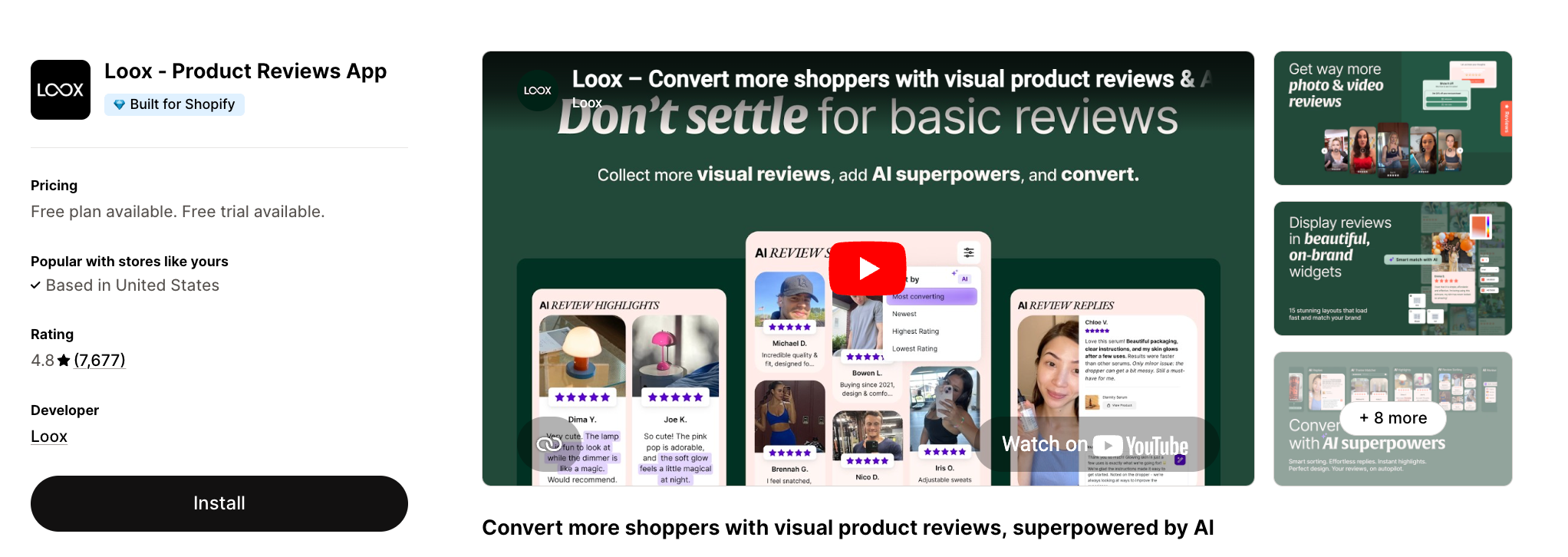
Shopify Rating: ⭐ 4.8/5 (7.6K+ reviews)
Loox overlaps with Judge.me, but it's the pick if aesthetics matter — visual-first brands in fashion, beauty, food, and home goods tend to prefer its gallery layouts and review automation.
It's also worth noting Loox bundles a full referral program into its reviews platform, which means the post-purchase review moment doubles as a new customer acquisition moment.
Best for: DTC brands where customer-generated visuals drive conversion more than written reviews
Key Features:
- Automated Photo & Video Review Requests: Post-delivery emails with incentives for visual submissions.
- Referral Program: Built-in referral flows triggered after purchase.
- Gallery Layouts: Carousels, grids, and pop-up displays that fit any brand aesthetic.
- Google Shopping & Meta Ads Integration: Star ratings on paid channels.
- Review Incentives: Auto-discounts for customers who submit photo or video reviews.
Considerations
- Video reviews gated to higher tiers
- Shopify-only, so not an option for multi-platform brands.
Pricing: Free plan available for up to 500 orders. Starts at $39.99/month for Scale, $49.99/mo for Convert, and $299.99/mo for Unlimited plan.
5. PageFly — Drag-and-Drop Landing Page Builder
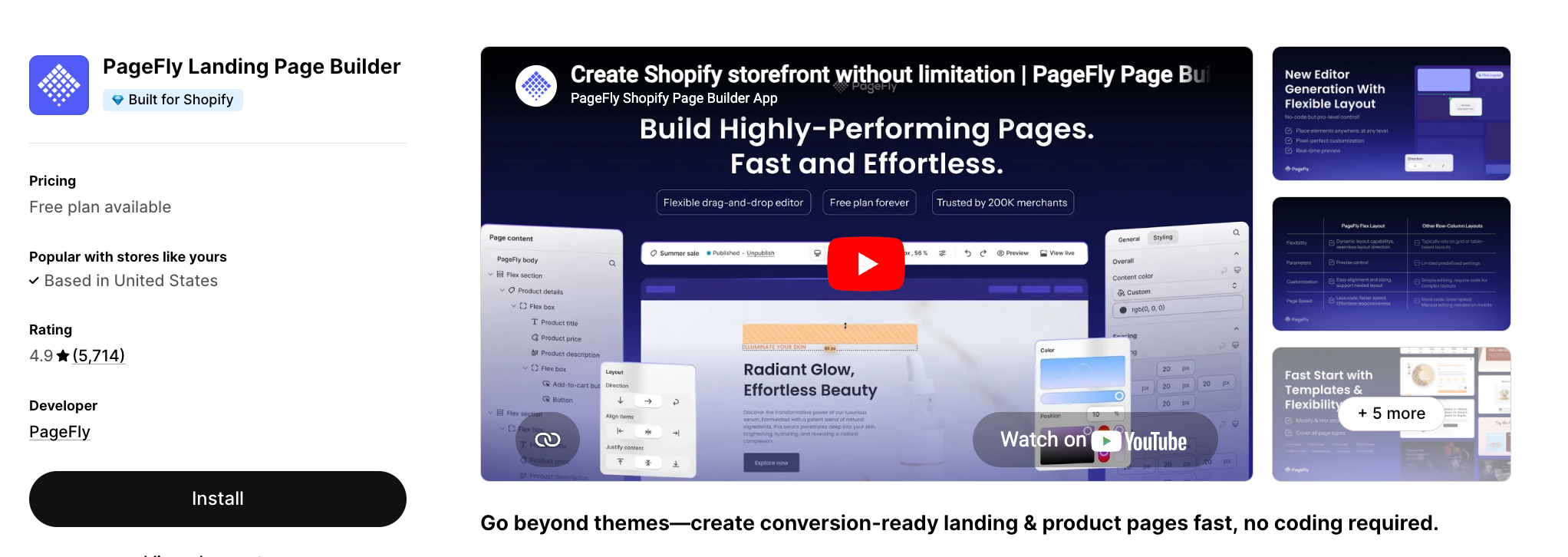
Shopify Rating: ⭐ 4.9/5 (5.7K+ reviews)
Shopify's native theme editor hits a ceiling fast. PageFly is the page builder most brands install when they need custom landing pages for paid campaigns, product launches, or niche collections that need a different layout from the main site.
It's especially useful for brands running paid traffic — ad-to-page congruence is a big conversion lever, and PageFly makes it possible to spin up a matched landing page in an afternoon instead of waiting two weeks for a developer.
Best for: Stores running paid traffic or product launches that need dedicated landing pages
Key Features:
- Drag-and-Drop Editor: Full design flexibility with no coding required.
- 200+ Templates: Product pages, landing pages, sales funnels, and about pages, all mobile-responsive.
- Mobile Breakpoint Controls: Design per device so mobile isn't an afterthought.
- Code Injection: Drop in custom HTML, CSS, or Liquid when needed.
- A/B Testing: Native split testing on premium plans.
Considerations
- Over-loading pages with widgets and animations can tank Core Web Vitals — keep layouts lean.
- Free plan is limited to 1 published page.
- The editor is more powerful than Shopify's native tools, which also means more buttons to get lost in.
Pricing: Free plan (1 page). Paid plans start at $24/month (Pay As You Go) and scale to $99/month (Unlimited).
Tip: Pair PageFly with Alia's advanced targeting to show different popups on different landing pages — so paid traffic from a specific ad sees an offer matched to that ad.
6. Attentive — Enterprise SMS Marketing

Shopify Rating: ⭐ 4.7/5 (100+ reviews)
For brands where SMS is already a meaningful revenue channel (typically 15–30% of email/SMS revenue), Attentive is the category leader. It's enterprise-grade, deeply integrated with Shopify, and built for brands that treat SMS as its own channel rather than an afterthought inside their email tool.
Best for: 7- and 8-figure Shopify brands that need SMS as a dedicated channel
Key Features:
- Two-Way SMS Conversations: AI-assisted replies with real conversation support.
- Compliance Engine: Built-in TCPA, CTIA, and global compliance handling — no guesswork.
- Advanced Segmentation: Tied to Shopify purchase and browsing behavior.
- MMS & Rich Cards: Interactive SMS formats beyond plain text.
- Dedicated Customer Success: Every enterprise account gets a strategist.
Considerations
- Custom pricing only — no public rates, which usually means premium.
- Optimized for brands with existing SMS lists of 10K+. Smaller brands should start with Klaviyo SMS or Postscript.
- Onboarding takes 2–4 weeks to get fully live.
Pricing: Free 30-day trial available; Custom pricing based on list size, message volume, and features. Expect several thousand per month minimum.
Read more: 11 Ways to Grow Your SMS List to Recover $10,000s in Revenue
7. Rebuy Personalization Engine — AI Upsells & Cross-Sells

Shopify Rating: ⭐ 4.7/5 (800+ reviews)
Rebuy uses machine learning and real-time behavioral data to personalize the shopping experience across cart, checkout, search, and post-purchase. Its standout feature — Smart Cart — is a fully customizable AI-driven cart drawer that surfaces personalized upsells based on cart contents and shopper behavior.
For stores focused on growing AOV, Rebuy is the gold standard.
Best for: Increasing average order value with smart product recommendations
Key Features:
- Smart Cart: AI-driven cart drawer with dynamic, personalized upsells.
- Checkout & Post-Purchase Upsells: One-click add-ons in Shopify checkout and thank-you pages.
- AI-Powered Search: Understands shopper intent to surface relevant results.
- Automated Merchandising: ML-based product promotion without manual rules.
- Analytics Dashboard: Track lift per widget and campaign.
Considerations
- Pricing scales with order volume, which can get expensive for high-volume stores.
- Feature depth creates a meaningful setup curve.
- Focused entirely on post-discovery — doesn't help with top-of-funnel lead capture.
Pricing: Free plan for dev stores. Free for Rebuy Monetize Plan. Paid plans start from $25/mo (Build Your Plan Package) and scale to $538/mo for premium features and support.
8. ReConvert — Post-Purchase Upsell & Thank-You Page Builder
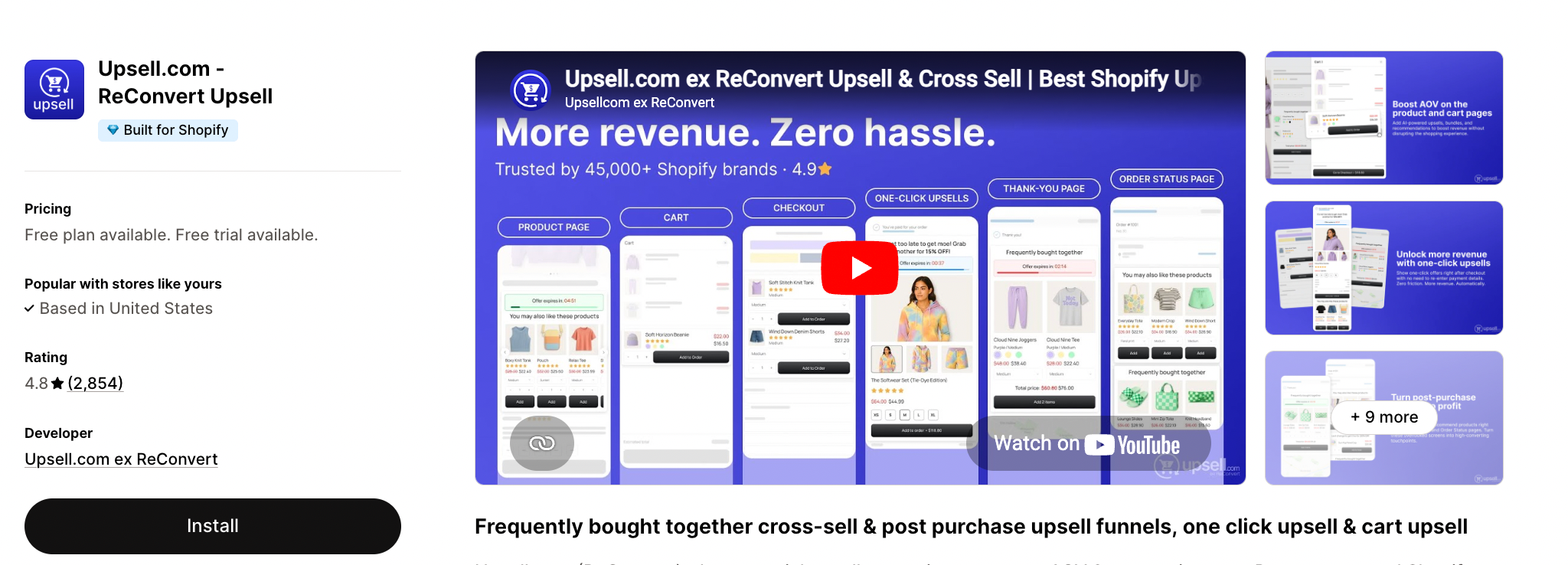
Shopify Rating: ⭐ 4.8/5 (2.8K+ reviews)
ReConvert turns the Shopify thank-you page — typically dead real estate — into a conversion surface. One-click upsells, surveys, birthday capture, and product recommendations all run post-purchase without re-entering payment info.
Best for: Brands looking for quick AOV lift without touching the main purchase funnel
Key Features:
- One-Click Post-Purchase Upsells: No re-entering payment info — customers accept the offer in a single tap.
- Customizable Thank-You Pages: Countdown timers, cross-sells, and surveys out of the box.
- Birthday Collection Widget: Feed your email segmentation with date-based triggers.
- Upsell Funnel Builder: Conditional logic for personalized follow-up offers.
- Analytics Dashboard: Shows revenue lift per widget.
Considerations
- Only works on the post-purchase side — pair with a popup tool for full-funnel coverage.
- Some templates feel dated and will need custom design work.
- Push too aggressive and you'll frustrate customers who just bought.
Pricing: Free plan available. Paid plans start at $4.99/month for up to 50 orders and scale up to $19.99 with monthly order volume.
9. Smile.io — Loyalty, Referrals & VIP Programs
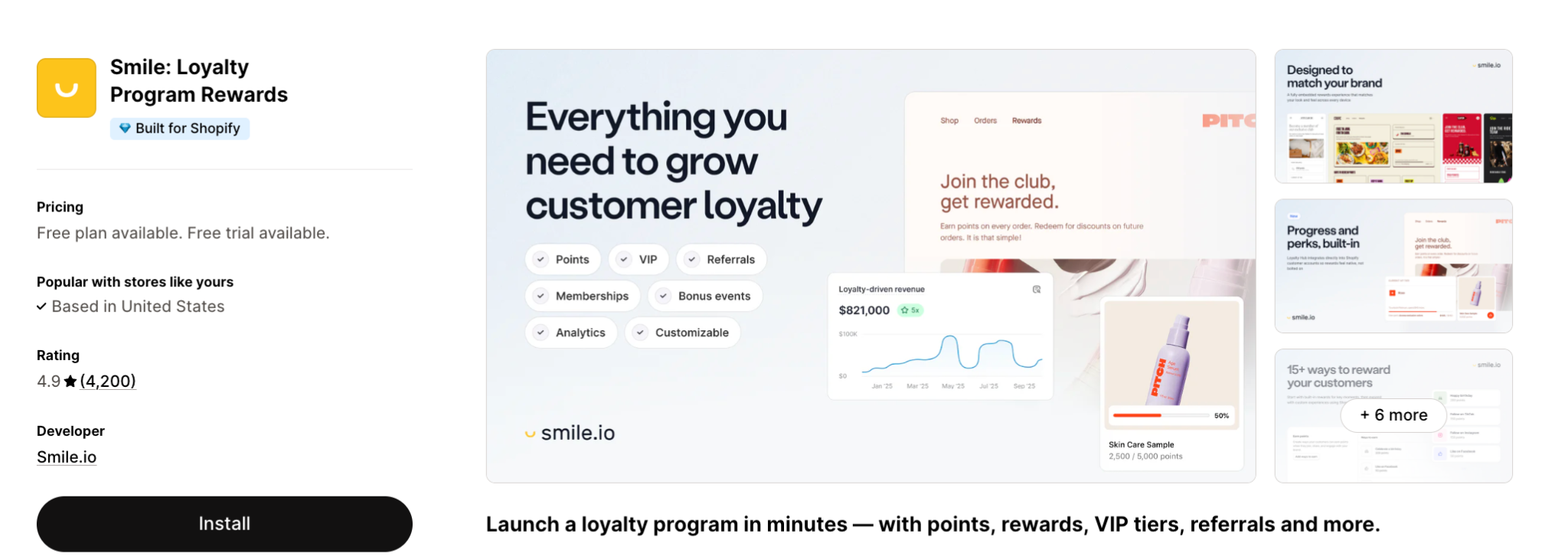
Shopify Rating: ⭐ 4.9/5 (4.2K+ reviews)
Smile.io is the most-installed loyalty app on Shopify. It handles points programs, referral flows, and VIP tiers without requiring a custom build — which means you can launch a functioning loyalty program in a single afternoon.
Best for: Brands with existing customer bases looking to drive repeat purchases and LTV
Key Features:
- Points-Based Rewards: Earn points for purchases, signups, birthdays, reviews, and social follows.
- Referral Program: Shareable customer URLs with automatic discount generation.
- VIP Tiers: Reward top customers with exclusive perks and earn-rate multipliers.
- Widget Customization: Loyalty launcher, points displays, and rewards page designs.
- ESP Integrations: Trigger emails via Klaviyo, Omnisend, and others based on loyalty events.
Considerations
- Free plan comes with mandatory Smile branding — removing it requires a paid plan.
- A loyalty program isn't a strategy on its own — it needs active promotion to customers.
Pricing: Free plan available for those with up to 200 monthly orders. Paid plans start from $15/mo and scale to $199/month for VIP features.
10. Gorgias — Ecommerce Helpdesk & Customer Service Platform

Shopify Rating: ⭐ 4.3/5 (600+ reviews)
Gorgias is the leading helpdesk built for Shopify. It centralizes email, live chat, social, SMS, and phone into one dashboard enriched with real-time Shopify order data — so every ticket shows order history, cart contents, and shipping status without toggling between tabs.
Its AI Agent autonomously resolves common tickets (order tracking, returns, cancellations) while giving agents the ability to process refunds, edit orders, and apply discounts directly from the ticket view.
Best for: Stores doing 500+ support tickets per month that have outgrown Gmail or Zendesk
Key Features:
- Unified Inbox: Email, chat, SMS, Instagram, Facebook, WhatsApp — all in one place.
- Shopify Data on Every Ticket: View orders, issue refunds, edit shipping without leaving Gorgias.
- AI Agent: Autonomously handles high-volume tickets using your help center content and Shopify data.
- Macros & Automation: Canned responses, auto-replies, and smart ticket routing.
- Revenue Attribution: Track sales generated by support conversations.
Considerations
- Ticket-based pricing can spike during sale periods like BFCM.
- AI Agent resolutions billed separately on some plans.
- Overkill for stores handling under 100 tickets/month — Shopify Inbox is enough for smaller operations.
Pricing: Starts at $10/month (50 tickets). Basic is $60/mo, Pro is $360/mo, Enterprise is custom.
11. Microsoft Clarity — Free Heatmaps & Session Recordings
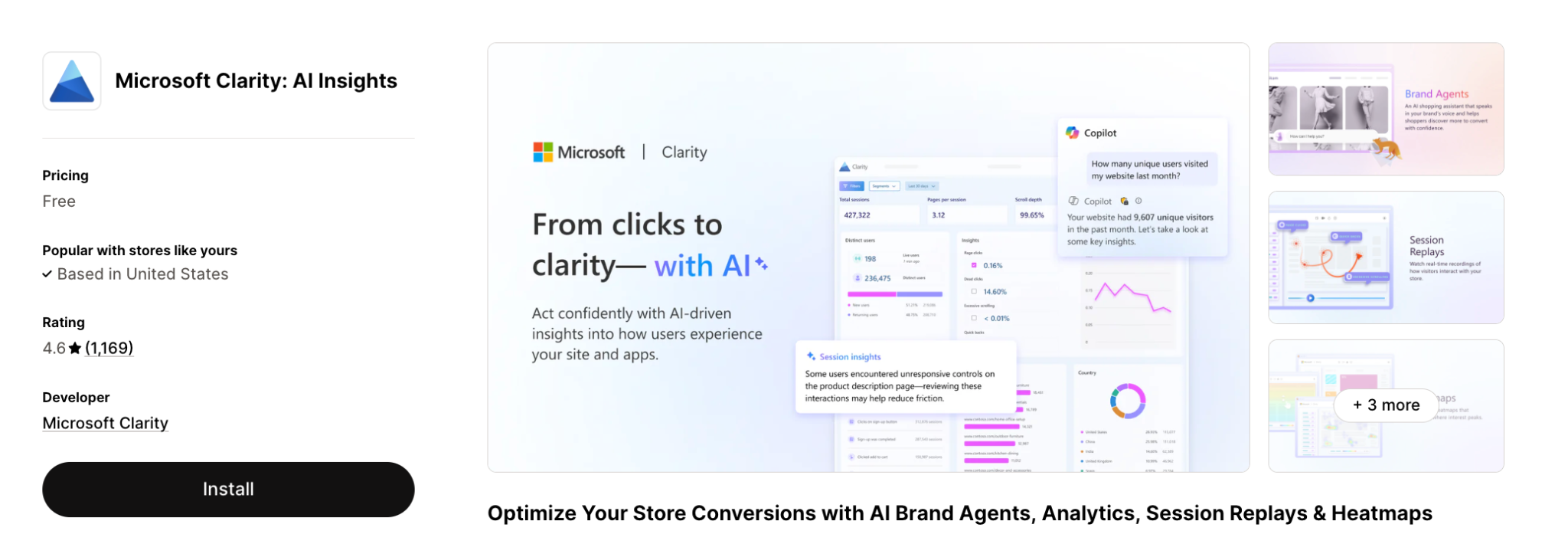
Shopify Rating: ⭐ 4.6/5 (1.1K+ reviews)
Microsoft Clarity is legitimately free — no trial, no data caps, no "upgrade to unlock" paywalls. It gives you session recordings, heatmaps, scroll depth tracking, and dead click detection at zero cost.
For any Shopify store, there's essentially no reason not to install it.
Best for: Every Shopify store — install on day one
Key Features:
- Session Recordings: Watch real visitors interact with your site.
- Heatmaps: Click, scroll, and mouse movement visualizations.
- Dead & Rage Click Detection: Surface UX friction patterns that are costing conversions.
- Insights Dashboard: Automated anomaly detection and friction flagging.
- Google Analytics Integration: Tie session data to GA events.
Considerations
- Microsoft collects and uses the data — read the privacy policy before installing.
- Recordings older than 30 days are auto-deleted unless exported.
- Less depth than paid alternatives like FullStory or Hotjar for power users.
Pricing: Free forever.
Tip: Watch 20 session recordings and you'll spot exactly where visitors hesitate or bounce — shipping costs, size charts, missing popup signup forms. That's the brief for what to fix next in your Shopify store's conversion rate.
12. Shopify Search & Discovery — Native Search & Merchandising

Shopify Rating: ⭐ 3.3/5 (400+ reviews)
Shopify's own Search & Discovery app has quietly become one of the most valuable free tools on the platform. Custom search synonyms, product boosts, filter and facet configuration, and related product recommendations — all without paying for a third-party search tool.
Best for: Every Shopify store with more than 20 SKUs
Key Features:
- Custom Search Synonyms: Map "sweater" to "jumper," "sneakers" to "trainers."
- Product Boosts: Pin best-sellers to the top of search results.
- Filters & Facets: Refine by price, size, color, vendor, and tags.
- Related Products Widget: Automatic recommendations on product detail pages.
Considerations
- Less sophisticated than paid alternatives like Searchanise or Boost — no AI merchandising or advanced analytics.
- Install-and-forget won't work. Setup requires an hour of configuration (synonyms, boosts, filters).
Pricing: Free.
13. Matrixify — Bulk Data Import/Export

Shopify Rating: ⭐ 4.9/5 (1.1K+ reviews)
Shopify's native bulk editor has limits. Matrixify handles the jobs it can't — bulk-editing thousands of product descriptions, migrating catalogs from other platforms, running scheduled exports, and managing metafields at scale.
Best for: Ops teams, agencies, and anyone who lives in spreadsheets
Key Features:
- Bulk Import/Export: Products, customers, orders, collections, metafields, discounts, and more.
- Excel & CSV Support: Custom column mappings for complex data structures.
- Scheduled Exports: Automated backups and recurring reports.
- Migration Tools: Move between Shopify stores or import from other platforms.
- Detailed Error Logs: Pinpoint why imports fail and fix at scale.
Considerations
- Learning curve rewards users who understand Excel — spreadsheet-averse merchants should stick with Shopify's native tools.
- Large migrations require paid tiers.
Pricing: Free for small jobs (up to 10 sheets, 10K rows). Paid plans start at $20/month.
14. Shopify Inbox — Free Live Chat
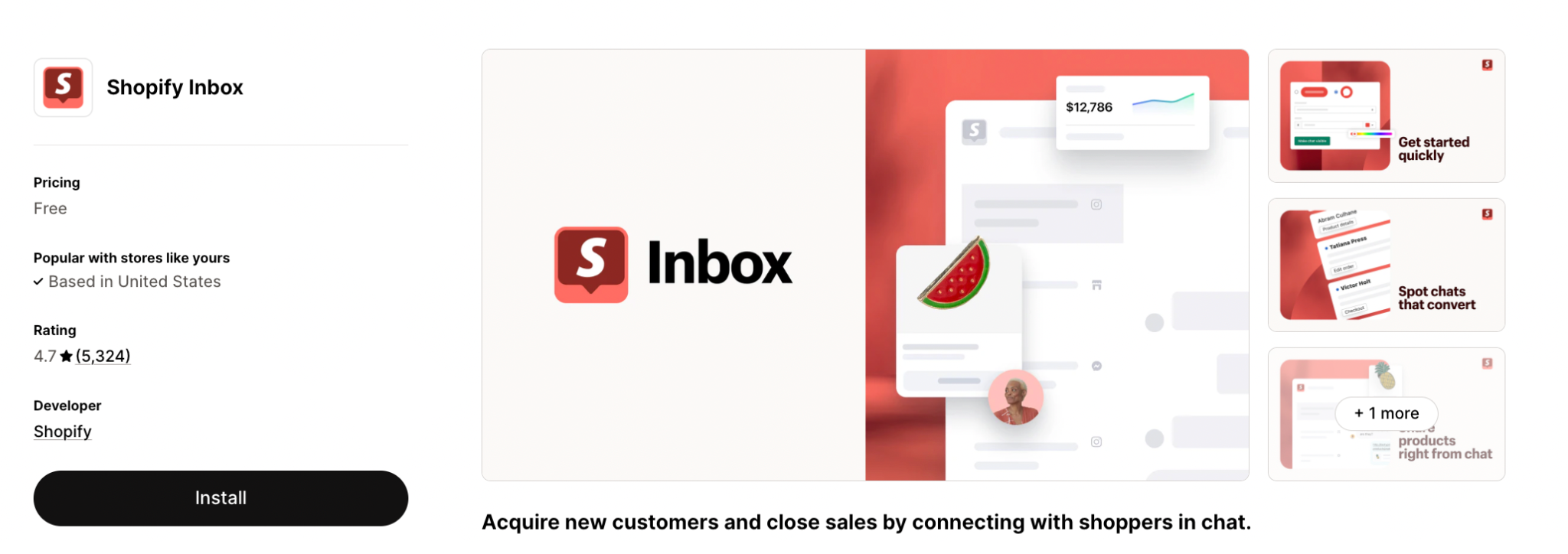
Shopify Rating: ⭐ 4.7/5 (5.3K+ reviews)
Shopify Inbox is the native messaging app — it adds a chat widget to your store and consolidates messages from email, Shopify chat, Facebook, and Instagram into a single inbox. Free, simple, and enough for most small-to-mid size stores.
Best for: Small stores that want clean live chat without paying for Gorgias
Key Features:
- On-Site Chat Widget: Customizable appearance and behavior.
- Unified Inbox: Chat, email, Instagram, and Facebook messages in one view.
- Quick Replies: Saved responses for common questions.
- Product Sharing: Drop product cards directly into chat conversations.
- Order Status Lookups: Built into the app for fast support responses.
Considerations
- Limited automation — no complex routing rules or AI agents.
- Single-seat workflows feel clunky with 3+ support agents.
- Reporting is basic.
Pricing: Free.
How to Build the Right Plugin Stack for Your Store
Installing 20 apps and hoping for the best is the fastest way to end up with a slow, bloated, conflict-prone site. Here's a cleaner approach:
Start with the bottleneck, not the category. Don't ask "what's the best review app?" — ask "what's stopping visitors from converting?" If the answer is trust, reviews are the lever. If it's "we barely capture any email signups," a lead capture tool like Alia is the lever. If it's low repeat purchase rate, loyalty is the lever.
Follow the money. Plugins that influence revenue (lead capture, email, SMS, upsells, loyalty) deserve more budget than plugins that influence operations. A $200/month popup tool driving a 25% opt-in rate pays for itself in its first week — a $10/month inventory tool saves time but doesn't move the top line.
Respect page speed. Every plugin adds JavaScript. Install eight on the home page and mobile load time tanks — and mobile is 70%+ of your traffic. Run a PageSpeed Insights check after every install.
Shopify-native beats multi-platform. Apps built exclusively for Shopify (Alia, Judge.me, Shopify Search & Discovery) integrate more deeply and break less often than apps ported from WordPress or other platforms.
Test, don't stack. Install one plugin at a time. Measure impact for 2–4 weeks. Keep or uninstall based on data, not vibes.
The Shopify Plugin Stack That Drives Real Growth
The healthiest Shopify brands aren't running one killer app — they're running a stack where each piece owns a specific job in the funnel:
- Top of funnel: Alia captures email and SMS from first-time visitors at 15–35% rates.
- Mid-funnel nurture: Klaviyo (or Omnisend, Sendlane) runs welcome flows, browse abandonment, and promotional campaigns off the data Alia captures.
- Product page: Judge.me or Loox surfaces reviews; PageFly handles custom landing pages for paid campaigns.
- Cart & checkout: Rebuy recommends upsells and cross-sells dynamically.
- Post-purchase: ReConvert captures a thank-you page upsell; Smile.io enrolls the buyer in loyalty.
- Customer service: Gorgias (or Shopify Inbox) handles support with full order context.
- Optimization layer: Microsoft Clarity watches what real visitors do; Shopify Search & Discovery refines on-site navigation.
Every plugin has a defined, revenue-adjacent job. None of them duplicate another's function. That's the pattern to copy.
The One Category Most Brands Underweight
Not every store needs every app. Start with the bottleneck costing you the most revenue and work outward.
If you look at where most 8-figure Shopify brands spend their attention, it's on email/SMS marketing, paid ads, and post-purchase optimization. But the single biggest leverage point on most Shopify stores isn't any of those — it's lead capture.
Here's the math: if your store captures 5% of visitors as subscribers and you bump that to 15%, you triple the size of your top-of-funnel without any additional ad spend. That tripled list compounds through every downstream flow — welcome series, promotional campaigns, product launches, BFCM — for the rest of the year.
Alia is the clearest ROI on this list. It's why brands like Fishwife, Portland Leather, and Essence Vault all run their email and SMS capture on Alia — and why their opt-in rates are 3–5x what they were on native Klaviyo or Shopify forms.
[Start your free 14-day trial on the Shopify App Store] [Book a personalized demo] [See full pricing]
Frequently Asked Questions
How many plugins should a Shopify store install?
Most healthy Shopify stores run between 8 and 15 active apps. Beyond 20 and you start seeing real page speed and conflict issues. Focus on apps with clear revenue or operational ROI and uninstall anything you're not actively using.
Will too many plugins slow down my Shopify store?
Yes. Every app injects JavaScript and CSS. Run Google PageSpeed Insights after every install, and uninstall apps you no longer use. Shopify-native apps (like Alia's one-click embed) tend to be better optimized than plugins ported from other platforms.
Are paid Shopify plugins worth it?
It depends on what they do. Plugins that influence revenue (Alia for lead capture, Klaviyo for email, Rebuy for upsells) almost always pay for themselves. Operational plugins (Matrixify) are worth it if they save hours of manual work. Plugins that duplicate Shopify's native functionality usually aren't.
What's the difference between a Shopify plugin and a Shopify app?
Nothing. The terms are used interchangeably — Shopify officially calls them "apps," but "plugins" is common shorthand, especially for users coming from WordPress.
Do I need a popup plugin if I already have Klaviyo or Shopify's native forms?
In most cases, yes. Klaviyo and Shopify native popups typically convert at 2–8%. Purpose-built popup tools like Alia average 15–20%+ because they use AI-driven triggering, continuous A/B testing, and Shopify-native behavioral data. Brands like Hostage Tape and Graza switched from native forms to Alia and saw 2–3x higher opt-in rates while keeping Klaviyo as their ESP.
.jpg)